
Benewah Deed Records by Type
Every recorded deed names the parties and describes the land. It also fixes the instrument's place in the county's public sequence. Expect a return address, an acknowledgment, and parcel or tax detail. A book/page or instrument reference appears as well. What estate actually passed depends on the words of the instrument itself. Mortgages, releases, easements, plats, judgments, and liens often sit beside the deeds in the recording trail. Pull them too when tracing ownership.
| Deed Type | What It Does | Common Use |
|---|---|---|
| Warranty deed | Conveys the stated estate with deed warranties | Ordinary arm's-length transfer |
| Quitclaim deed | Conveys whatever interest the grantor has | Family or title-cleanup transfer |
| Trustee or executor deed | Conveys through a trust or estate representative | Trust and estate administration |
| Tax deed | Follows the statutory delinquent-tax process | Property not redeemed in time |
| Easement instrument | Creates or records a defined use right | Road, utility, access, or land use |
A deed conveys an interest. A mortgage, deed of trust, or lien works differently. It secures or asserts a claim, and the named creditor does not thereby own the parcel. Always search the releases and reconveyances that follow an original claim, since only they show whether a recorded burden on the property was later cleared.
Benewah Recording Starts at Suite 101
The Benewah County Auditor/Clerk serves as the county recorder. The office sits at 701 W College Avenue, Suite 101, St. Maries, Idaho 83861, open Monday through Friday from 9 a.m. to 5 p.m. Call 208-245-3212 before any visit or copy order. The county's own page exposes no fields for grantor, grantee, date, document type, book/page, or instrument number. It publishes no coverage year, image cutover, result cap, subscription gate, or fraud-alert signup either. That absence is simply how the county runs recording. A direct inquiry replaces any online index search. The official recording landing page displays the office's contact and channel details.
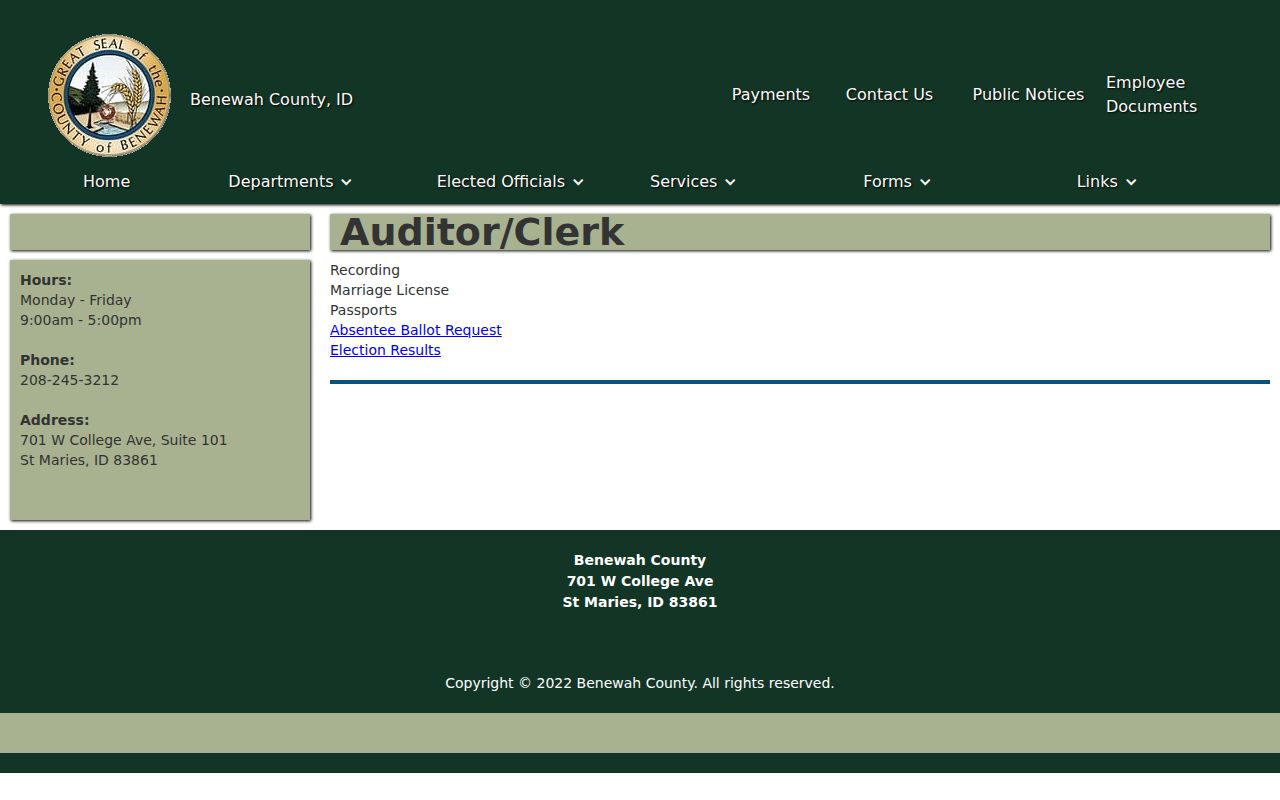
The county's recording page points every deed search back to the office channel. An actual index lookup requires a direct inquiry to the clerk.
Request a Benewah Deed Search
A strong request hands the clerk several ways to pin down the instrument. Include current and prior party names. Include the parcel or PIN, situs and mailing addresses, and a full or partial legal description. Add likely recording dates and the instrument class. Ask staff to return index references first, then request only the pages you truly need.
| Request Detail | Why It Helps | Benewah Source |
|---|---|---|
| Grantor and grantee | Locates transfer parties | Deed or GIS owner clue |
| Date range | Limits the book or index run | Known sale, estate, or notice date |
| Parcel and legal description | Separates same-name land | County GIS popup or prior deed |
| Instrument type | Targets deed, release, easement, lien, or plat | Purpose of the search |
Phone, mail, and counter routes all work. A formal Idaho Public Records Act request offers another path when a record is not readily at hand. Send it to the office that keeps the record, never a general county inbox.
Trace Benewah Grantors and Grantees
The grantor transfers the interest. The grantee receives it. A chain of title is the ordered run of instruments through which that interest passed from hand to hand. Benewah publishes no index screen or online cutoff, so the clerk must confirm the form of both older and current index references.
- Use the parcel map to collect the current displayed owner, parcel identifiers, and legal-description parts.
- Ask for the deed in which that owner appears as grantee, then note the grantor, date, land description, and recording reference.
- Search the grantor as an earlier grantee and compare the legal description before adding that transfer to the chain.
- Repeat backward, checking deeds, releases, easements, liens, and plats that affect the same land.
- Grantor
- The party that transfers the stated interest.
- Grantee
- The party that receives the stated interest.
- Chain of title
- The sequence of recorded transfers tied to the same land.
- Book and page
- An older physical-volume reference, such as Book U, page 424.
- Instrument number
- A unique recording reference that the clerk may use for a newer filing.
A 1931 Benewah Deed-Book Clue
An official Idaho Department of Lands appraisal reproduces an easement from Benewah County records. It was filed July 11, 1931, in Book U of Deeds, page 424. The document leans on public-land-survey and metes-and-bounds terms. It works as a real model for an old-record request. It also confirms that book/page indexing existed at that date. One instrument proves little more. It does not establish the full surviving run. Nor does it fix an online start date or a digitization year. Nothing in the county's published history points to a deed-book loss. Give the clerk the book, page, and year when seeking the easement or a nearby entry. Include the parties and the land description too. Note: A historic citation locates a record; it does not prove today's ownership is unchanged.
Pre-1915 Benewah Deed Records
Benewah County was created January 23, 1915, from the southern reach of Kootenai County. Transfers before that date may sit under the predecessor county's index. Ask the Benewah recorder where local volumes begin and whether copied or successor indexes exist. Then take the older tract question to the Kootenai recorder. You can also ask the Idaho State Historical Society. The State Historical Society catalogs open ArchivesSpace, research-library, newspaper, digitized-collection, and finding-aid routes. Not every collection is cataloged online. An email or phone research request may still be needed. Try name variants such as Benewah, Benwah, Benoit, St. Maries, and Saint Maries when working with old descriptions.
Benewah Easements and Liens
Read the deed chain alongside the instruments that burden or clarify it. Easements and rights-of-way can define access. Mortgages and deeds of trust secure debt. Assignments move an interest. Releases or reconveyances can clear it. Judgments and other liens join the land trail once recorded against the parcel.
Litigation can supply leads too. Quiet-title, partition, foreclosure, probate, and judgment cases start with Idaho iCourt for basic case data. The Benewah courthouse kiosk or clerk can then supply available documents. The August 2026 kiosk interface locates case information and hearings without a party name or case number. Court files and recorded land instruments remain distinct sources, so pull both when the story is unclear.
Benewah Parcel Labels Versus Deeds
Benewah County keeps ownership records current through the Assessor. The GIS map searches the DisplayNam owner field. What the county does not publish is a set refresh interval. So the lag between a recorded deed and a map update stays unknown. A newly recorded deed can still be fresher. It may better show who owns a Benewah parcel.
Copy the details from the GIS first. That means the owner label, mailing and situs addresses. Add the parcel, PIN, and AIN. Include the subdivision, lot, block, township, range, and section. Hand those clues to the recorder, then compare the legal description on the returned deed. A spelling change alone does not signal a mismatch. Trusts, entities, estates, and shortened names often display differently. Names can shift from file to file in Benewah County property records.
Benewah Deed Fees Need Confirmation
Benewah County posts no local fee schedule for deed copies. The Idaho recorder manual does list statewide statutory references. It covers electronic and paper copies of recorded documents. It also covers certified and compared copies. But the actual charge for a specific Benewah request has to come from the clerk.
A few questions will settle the cost. Ask whether the deed search itself carries a staff-time charge. Ask whether results can go out by email. Ask how many pages the deed runs, and what certification adds. For a large order, request index references before paying for images. Idaho Public Records Act processing rules can both apply to one deed records request. So can recorder record fees.
No Benewah Fraud Alert Found
Benewah County offers no property-fraud alert signup on its recording page. Do not enroll in another county's service. Do not assume one covers Benewah land. The local fallback is simple: ask the recorder for periodic name-based checks on Benewah County property records, and ask whether a notification program has launched.
Watch for warning signs. Unexpected mail, a parcel-owner change, or an unauthorized document deserves a call to the Auditor/Clerk. Keep the instrument reference handy. No private data removal service can change an official recorded deed.
Order a Benewah Deed Copy
Start with the Auditor/Clerk by phone, by mail, or at the Suite 101 counter. Bring the grantor and grantee names. Bring the approximate recording date, the deed type, parcel identifiers, the legal description, and any book/page or instrument number you know. Ask for a plain copy for everyday research. Ask for a certified copy when an official certification is required for the deed records.
Benewah County offers no public deed image and no online checkout. Confirm the current search, page, delivery, and certification charges before paying. If staff cannot locate the deed, widen the party spelling. Search the legal description instead. For a pre-1915 transfer, move on to predecessor Kootenai records.
Recorded, not guaranteed. Benewah County deed records show instruments accepted for recording. They are not a title opinion, and unrecorded interests or defects may exist.